18 October 2026
Howey-in-the-Hills Area Tips for Matching Gutters to Rooflines, Trim, and Exterior Style
Presented by @drainagejournal299
Choosing gutters sounds straightforward until you stand in the driveway and realize they will run across almost every visible edge of the roof. On many homes in and around Howey-in-the-Hills, gutters are not a minor add-on. They frame the eaves, sit against fascia and trim, and can either disappear gracefully or pull the eye in all the wrong directions.
In Central Florida, that visual decision also has to work under very practical conditions. Summer thunderstorms, tropical weather, humidity, leaf litter, and fast-moving runoff all put pressure on the system. Gutters here need to look right, but they also need to move water away from the house and into areas that can absorb it. That matters for foundations, landscaping, outdoor living spaces, and the overall upkeep of the home.
The best gutter choices are rarely made by looking at a color chip alone. They come from reading the whole exterior, roofline first, trim second, and style third. Once those three are working together, the home tends to look more finished, and the drainage plan usually makes more sense too.
Start with the roofline, not the gutter brochure
A lot of homeowners begin by shopping colors or profiles, which is understandable. The more reliable approach is to walk the property and study the roofline from the street, the driveway, and the backyard. The roofline tells you how visible the gutters will be, where the eye naturally lands, and whether the house benefits from contrast or from restraint.
On a simple roofline with broad, clean eaves, gutters usually read as a long horizontal line. If you pick a strong contrasting color, that line becomes a major design feature. That can work on the right house, especially when the trim is already used to define edges. On a more complex roof with multiple planes, corners, and changing heights, a quieter gutter choice often works better because there is already enough visual movement overhead.
This is one of those decisions that seems small on paper and obvious in person. I have seen homes where a gutter color looked perfect on a sample but felt too busy once it wrapped every eave. I have also seen the opposite, where a slightly deeper color made a washed-out exterior look sharper and more intentional. The difference is usually the roofline itself. Long, uninterrupted edges amplify whatever color and shape you choose.
Homes near Howey-in-the-Hills often have outdoor spaces that are just as important as the front elevation. A rear roofline over a lanai or patio deserves the same attention as the front. If the gutter line is visible from the pool deck or a favorite seating area, it becomes part of daily life, not just curb appeal.
Matching gutters to trim, fascia, and soffits
If the roofline tells you how much attention the gutters will get, the trim tells you where they should visually belong. In most cases, homeowners are happiest when gutters relate clearly to either the fascia or the trim package. Problems tend to show up when the gutter color tries to split the difference and ends up matching nothing.
When gutters blend with fascia, the home usually looks tidy and cohesive. The eye reads the roof edge as one continuous finish rather than separate parts. This is often the safest move if you want the system to disappear as much as possible. It is especially effective on homes with clean lines or with a lot of visual detail elsewhere, such as shutters, stone accents, or a prominent front entry.
Matching gutters to trim can also work well, but it creates a different effect. Instead of fading away, the gutters become part of the home’s outlined edges. That can sharpen the architecture and give the exterior more definition. It tends to look best when the trim itself already has a deliberate, repeated role around windows, columns, or corners.
The mistake I would avoid is treating gutter colors for Florida homes as purely decorative. In bright sun and heavy rain, every edge on the house gets highlighted. A color that seems subtle in shade can look much stronger at noon. A finish that looks soft on a showroom sample may look harsh against white soffits under full Florida light. It helps to look at any option outdoors, not under store lighting, and to compare it against the trim and roof at the same time.
Exterior style should lead the finish choice
Not every house wants the same kind of gutter presence. Exterior style matters because it sets the rules for how much contrast and detail the home can carry.
A traditional house with balanced windows and visible trim usually handles a more defined gutter line well. If the trim package already outlines the structure, the gutters can join that composition without feeling forced. A simpler ranch or a home with broad stucco surfaces often benefits from gutters that recede, because too many outlined edges can make the exterior feel chopped up.
Mediterranean-influenced homes, which are common in many Florida communities, can be trickier. These houses often rely on smooth wall planes, roof shape, and restrained trim. On them, a high-contrast gutter can interrupt the architecture. A closer match to the fascia or surrounding finish is often more comfortable to the eye. That does not mean every gutter should vanish, only that the style usually looks better when roof drainage is integrated rather than highlighted.
Metal roofing brings another layer to the decision. Homeowners searching for gutters for metal roofs Florida properties often focus on compatibility and weather performance, which is smart, but the visual side matters too. Metal roofs can make the whole exterior look crisper and more linear. That means any gutter line attached to them will look more intentional, for better or worse. With metal roofing, I generally think in terms of discipline. The cleaner the roof reads, the more careful you need to be with gutter color, line, and drainage placement so the finished result looks planned instead of pieced together.
Why drainage design affects appearance more than people expect
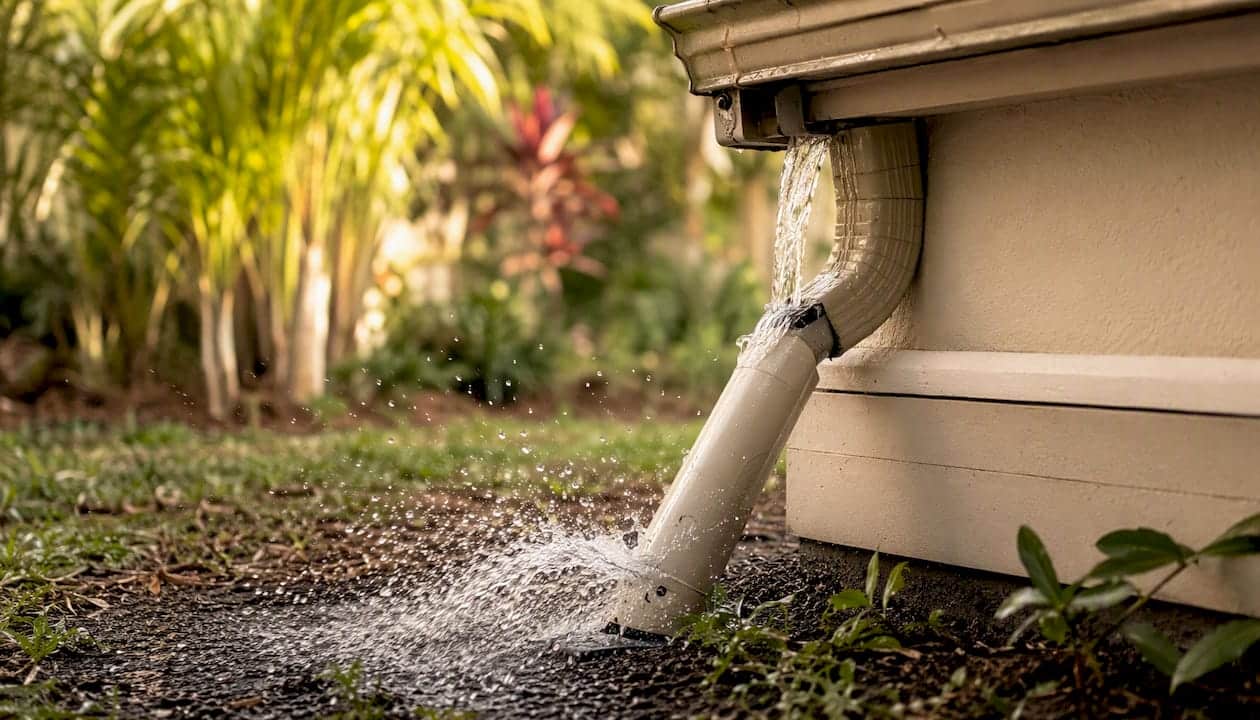
Good-looking gutters can still make a house feel awkward if the downspouts land in the wrong places. In Florida, directing roof runoff away from the house and into areas that can absorb it is not just a maintenance issue. It affects the appearance of the entire exterior.
UF/IFAS guidance is clear that downspouts should direct water away from the foundation and into lawn, planting beds, rain gardens, or other pervious areas when possible. That helps reduce runoff and erosion, and it can also prevent pooling near the house. Pooling water is not only hard on the property, it also creates the kind of damp, messy edge that makes even a nice exterior look neglected.
This is why I never think of gutter matching as color alone. Downspout placement changes the visual balance of a wall. If one side of the house gets a clean, tucked-away run and another side ends up with a long visible extension crossing a walkway or splashing into bare soil, the whole design suffers.
This comes up often around screened enclosures and patios. Gutter drainage for pool cages deserves extra attention because outdoor living spaces are where poor drainage becomes obvious fast. If runoff creates muddy edges, erodes planting beds, or sends water where people walk in and out of the enclosure, the issue feels bigger than a simple gutter mismatch. It becomes part of how the backyard functions. Around pool-adjacent spaces, neat routing and sensible discharge areas matter just as much as color coordination.
Seamless appearance, visible reality
A lot of homeowners like the idea of a streamlined finish, and for good reason. Phrases like seamless gutters Williston FL show up in searches because people want a cleaner look with less interruption across long roof edges. Even without getting into product claims, the design appeal is easy to understand. Fewer visual breaks usually make the eaves look calmer and more finished.
Still, a smooth visual line only works if the supporting details are handled well. Corners, downspout turns, and end points are where the eye catches problems. A beautifully matched gutter color cannot rescue an awkward downspout route or a discharge point that stains the wall or splashes mulch across the patio after every storm.
In practice, the nicest installations tend to be the ones where someone thought through both the long view and the close view. From the street, the gutters should suit the architecture. From ten feet away, the transitions and terminations should still make sense.
HOA approval can shape color choices
In some neighborhoods, especially planned communities, exterior updates are not purely personal. Florida law gives homeowners associations authority over exterior appearance standards, including color and style specifications for certain exterior components. At the same time, those standards have to comply with code and cannot be used to deny conforming installations.
For a homeowner, that means gutter colors for Florida homes may be partly a design question and partly a paperwork question. It is worth checking the community standards before settling on a finish, especially if the home is in a neighborhood where trim colors, roof appearance, or visible exterior additions are reviewed.
This does not mean every decision gets complicated. It simply means that if you are trying to match gutters to rooflines and trim, you want to know the allowed range before you fall in love with a particular color. I have seen people waste time comparing subtle tones when the association only permits a narrow set of approved exterior finishes. A quick check early on can save a lot of backtracking.
Cost affects style choices, even when people pretend it does not
Budget does not have to control every decision, but it always shapes them. When people ask about gutter installation cost factors Florida homeowners should keep in mind, they are often thinking about price alone. What really happens is that cost influences the design choices too. The more complicated the roofline, the more opportunities there are for visible transitions, corners, and drainage decisions that affect both appearance and function.
A straightforward roof edge is easier to make look clean. A house with multiple elevations, long runs, or awkward discharge points requires more judgment. That is where people sometimes overspend on a finish but under-think the layout, or they spend heavily on one visible elevation and ignore a problem area in the rear yard where water actually needs better control.
The sweet spot is usually a balanced approach. Put money into the choices that affect both the look and the drainage outcome. A gutter system that suits the home and sends water into absorbent areas is doing real work. A system that only looks good in the front photo is not enough in Florida.
The most common myths make matching harder
There are a few gutter myths Florida homeowners run into again https://gutterguide411.novacrestiq.com/posts/repair-or-replace-gutters-in-lady-lake-villages-area-what-homeowners-should-review and again, and they can lead to poor decisions. One myth is that gutters are mainly cosmetic. In this climate, regular storms and runoff make that hard to defend. Another is that any downspout location is fine as long as water leaves the roof. It is not, especially if the discharge point encourages erosion or lets water collect near the foundation.
The third myth is that maintenance can be ignored once the color and style look right. UF/IFAS materials point out that gutters and downspouts require upkeep because debris and leaf litter contribute to drainage problems. A beautiful match between gutter, trim, and roofline will not stay beautiful if overflowing water stains the exterior or dumps debris onto walkways and planting beds.
This is one reason I am cautious when homeowners focus only on accessories or add-ons. Searches for gutter guards Mount Dora FL come from a real need to reduce maintenance headaches, but guards do not erase the need to check how the system is performing. In a storm-heavy, debris-prone environment, the question is never just whether something is installed. The question is whether water is moving where it should, in the amount it should, without creating a new mess somewhere else.

Maintenance is part of the visual design
A sharp-looking gutter system is not a one-time victory. It stays attractive when it drains properly, stays attached properly, and does not constantly overflow at the same corners.
That is why the old debate of DIY gutter cleaning or hire a pro is not really about pride. It is about access, safety, and whether the person doing the work can also spot trouble early. If the roofline is steep, the runs are high, or the home has hard-to-reach areas around lanais or cages, the safer option may be professional help. If the setup is simple and accessible, some homeowners are comfortable handling routine debris removal themselves. The real goal is not who does the cleaning. The goal is that the gutters keep functioning and that small issues are caught before they become ugly ones.
Overflowing water is one of the fastest ways to ruin the neat look of a well-matched exterior. Streaks, splashback, washed-out mulch, and soggy foundation beds make a house feel uncared for even when the paint and trim are in great shape. That is why local searches like gutter cleaning Dunnellon FL and gutter repair Hawthorne FL reflect something practical, not just routine service shopping. In Florida, maintenance is part of preserving the appearance of the home.
A simple way to judge whether the match is right
When I help homeowners think this through, I ask them to stand in three places: the street, the front walk, and the main backyard sitting area. If the gutters look appropriate from all three, the choice is usually solid. If they disappear too much in one view and dominate another, the match probably needs another look.
Here are the five things worth checking before you commit:
- Whether the gutter color belongs more naturally with the fascia or the trim.
- Whether the roofline is simple enough to carry contrast without looking busy.
- Whether downspouts can be routed to lawn, beds, or other pervious areas away from the house.
- Whether backyard features like patios, lanais, or pool cages will expose awkward drainage.
- Whether neighborhood or HOA standards limit visible finish choices.
That short check catches most of the regret points before installation begins.
What to notice through the year in Florida
Because Florida weather does not really give gutters a long offseason, the smartest homeowners keep an eye on performance year-round. A year-round gutter checklist Florida residents can actually use is less about formal scheduling and more about noticing changes after storms, during leaf drop, and around the wetter parts of the year.
Watch where water lands during a heavy rain. Notice whether mulch is washing out, whether a bed near the foundation stays soggy, and whether splash marks appear on siding or stucco. Look at the corners and outlet areas after debris season. Pay attention to any place where runoff crosses a path or collects near outdoor living areas. These are not glamorous observations, but they tell you whether the gutter system still suits the home as well in practice as it did on installation day.
A house in Howey-in-the-Hills can look polished from the curb and still have a drainage mismatch at the rear corners. That is common, especially where landscaping matured after the gutters went in or where a patio or enclosure changed how water behaves around the property. Small course corrections matter.
The homes that look best rarely chase attention
The nicest gutter matches are usually the ones you do not notice right away. You notice the roofline. You notice that the trim feels crisp. You notice that the house looks settled and coherent. Then, if you look more closely, you realize the gutters are doing a lot of work without demanding credit for it.
That is the target for most homes around Howey-in-the-Hills. Not flashy, not invisible for the sake of it, just right for the roof shape, the trim, the yard, and the way Florida rain actually moves across the property. When the gutters fit the architecture and the drainage plan respects the landscape, the whole exterior works better. It looks cleaner, holds up better, and feels more thought through every time the afternoon sky opens up.